Most people in England have a working understanding of what a healthy portion looks like. The problem is that this understanding is formed against a reference landscape that has shifted substantially over the past thirty years — one in which the portion sizes delivered by restaurants, packaged goods, and takeaway outlets have grown in ways so incremental that the recalibration of expectation goes unnoticed.
How Portion Distortion Develops Without Awareness
Portion distortion is not a personal failing. It is a systematic consequence of an environment in which the visual and physical cues that would ordinarily indicate "enough" have been consistently inflated. A dinner plate that would have held a standard restaurant portion in 1990 looks austere against the plates that arrive in most UK restaurants today. A serving of pasta or rice that matches the nutritional standard would strike most diners as insufficient — because the reference point they carry has been built from the larger portions they encounter most frequently.
Research on this phenomenon, developed extensively by the food behaviour researcher Brian Wansink and subsequently examined by independent replication studies, established that people use environmental cues — plate size, package size, serving container depth — as primary guides to appropriate portion size, overriding physiological fullness signals in the process. When larger containers and plates are provided, people serve themselves more and consume more, typically without awareness that the quantity has changed. This is not a cognitive override of the instinct to eat; it is the instinct to eat operating exactly as designed in an environment it was not designed for.
The UK food environment compounds this through the packaging conventions of the processed food industry. Multi-serve packages, designed for a stated two or more servings, are frequently consumed as single servings — not because the consumer ignores the label, but because the package is presented as a unit and the stated portion looks implausibly small against the amount the consumer expects to eat. A bag of crisps, a bar of chocolate, a punnet of prepared food: each of these is sold in a package that, by its physical format, implies a single occasion of consumption regardless of what the label says.
The downstream effect on weight management is significant. If a person consistently consumes two to three hundred additional calories per day through portion sizes that feel entirely normal but exceed a reasonable intake, the arithmetic accumulates with a consistency that no amount of attention to individual food choices can address. Portion distortion is not a crisis; it is a quiet compound interest on small regular overshoot.
"A portion is not an absolute quantity. It is a social and contextual expectation, and it has been reshaped by three decades of gradual commercial inflation."
Hidden Sugars in Everyday Food: Beyond the Obvious Categories
The conversation about hidden sugars in everyday food has historically centred on soft drinks and confectionery — the visible categories of sweet food where high sugar content is expected and understood. The more nutritionally consequential story lies in the categories where sugar appears as a functional ingredient in foods not primarily identified as sweet: savoury sauces, bread, processed meats, condiments, flavoured dairy products, "healthy" cereals, granola bars, and the broad category of reduced-fat products in which sugar serves as a flavour substitute for removed fat.
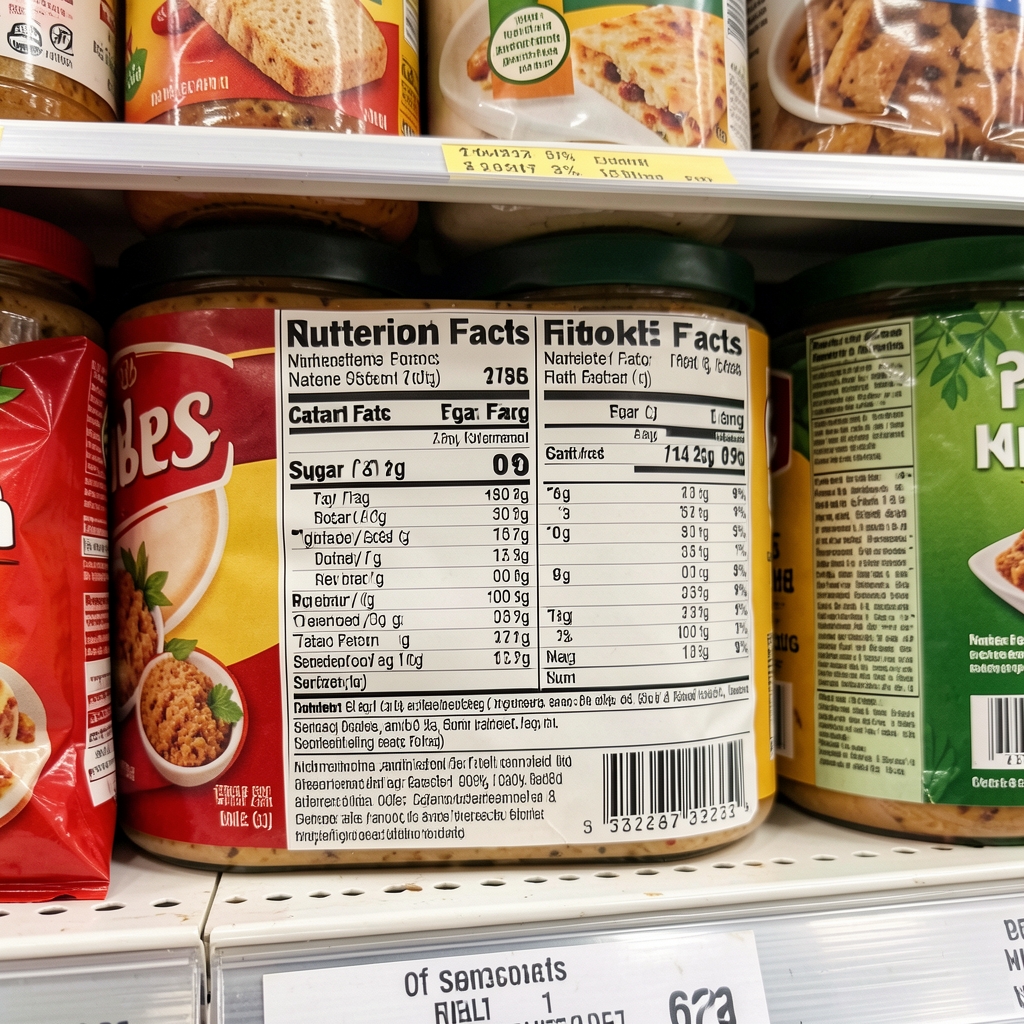
A standard jar of pasta sauce from a UK supermarket contains, in a single serving, between four and eight grams of added sugar. A serving of commercially produced granola may contain twelve to fifteen grams. A low-fat flavoured yoghurt can contain more sugar per serving than a small bar of chocolate. None of these products is primarily experienced as sweet by the consumer. They occupy a mental category of "normal food" or even "healthy food" that does not trigger the same awareness as an obviously sweet item.
This category error — the absence of a mental flag for sugar content in savoury and nominally healthy foods — means that a person making careful choices at the confectionery and soft drink level may still be consuming substantial added sugars through foods they consider neutral or virtuous. The total daily intake of added sugars across such a day may exceed the UK recommended maximum (30g for adults) through the accumulated contribution of foods that feel wholesome and appropriate at each individual point of consumption.
The practical question this raises for everyday eating is not a counsel of intense label scrutiny at every supermarket visit — that approach is neither sustainable nor enjoyable. It is, rather, an argument for a revised mental model of where sugar appears: primarily in processed foods, regardless of their apparent sweetness, and less in the unprocessed foods (fruit, vegetables, unprocessed grains, plain dairy) that do not rely on sugar for palatability.
Refined Carbohydrates, Weight, and the Satiety Gap
Refined carbohydrates and weight are linked in the nutritional literature through several well-described pathways. The most direct is the satiety gap: meals dominated by rapidly digestible refined carbohydrates (white bread, white rice, processed breakfast cereals, pasta from refined flour) produce a faster insulin response and a subsequent appetite signal that arrives sooner than the equivalent caloric value from less-refined sources. A person eating a white-bread sandwich at noon may find themselves genuinely hungry two hours later, not because they ate too little, but because the composition of what they ate produced a different appetite trajectory.
This satiety gap translates, across studies of large populations, into a tendency towards higher overall daily energy intake among people whose diets are dominated by refined carbohydrates. The relationship is mediated through multiple mechanisms — insulin dynamics, gut microbiome composition, appetite signal patterns, and fibre content — and is not reducible to any single pathway. What matters practically is the observation that calorie-for-calorie, refined carbohydrate sources tend to produce a shorter period of fullness than their whole-grain or protein-rich equivalents.
High-salt food habits intersect with this picture in ways that are not always immediately obvious. Salt-heavy foods tend to be heavily processed foods, and heavily processed foods tend to be refined carbohydrate-heavy. The association between high dietary sodium and weight gain is partly a proxy for ultra-processed food consumption rather than a direct effect of sodium itself. A person addressing their salt intake by choosing less processed food will, typically and automatically, also be addressing their refined carbohydrate intake — the two are structurally entangled in the UK processed food landscape.
The argument for gradual dietary improvement in this domain does not require elimination of refined carbohydrates from the diet. It requires, rather, a shift in the ratio: more of the daily carbohydrate intake from sources that carry fibre, protein, and micronutrients alongside their energy content. This shift does not need to be dramatic to produce a meaningful change in the satiety profile of the day's eating, and in the behaviour that follows from that profile.
-
01.
Portion distortion is an environmental effect, not a personal one — it develops through exposure to inflated portion norms in restaurants, packaged goods, and takeaway formats over time.
-
02.
Hidden sugars appear most consequentially in savoury processed foods, condiments, and reduced-fat products — categories not flagged as sweet by sensory experience or mental association.
-
03.
Refined carbohydrates produce a shorter satiety window than equivalent calories from whole-grain or protein sources, contributing to higher total daily intake without altered appetite experience at the meal itself.
-
04.
High dietary sodium and refined carbohydrate intake are structurally linked in processed food patterns — reducing one typically reduces the other without requiring separate effort.
Habit-Based Eating and the Architecture of Gradual Change
The consistent finding across nutritional behaviour research is that knowledge of portion sizes, sugar content, and refined carbohydrate effects does not reliably translate into changed eating behaviour. The gap between understanding and action is one of the most studied problems in health communication, and the conclusion is that information alone — even accurate, well-presented, personally relevant information — produces modest and often short-lived behaviour change in the domain of eating.
What produces more durable change is the modification of eating habits at the structural level: the way food is purchased, stored, prepared, and served. Habit-based eating is not a euphemism for rigid dietary rules; it refers to the observation that eating patterns are primarily maintained through routine and environment rather than through active deliberation at each eating occasion. Most of the time, people eat what is available, in the format and quantity that feels normal, at the times that are habitual.
This means that gradual dietary improvement is most effectively pursued by changing the composition of what is available and what is habitually served, rather than by attempting to override existing habits with new decisions at each meal. A household that normally serves pasta from white flour will gradually shift towards a different satiety profile if, over several shopping trips, the pasta purchased is gradually replaced with a higher-fibre equivalent — not because a rule was followed but because the alternative is no longer present to serve.
There is a quietness to this approach that is at odds with the urgency that typically characterises advice about eating change. It does not produce a dramatic reorientation on a given Monday; it produces a steady and barely perceptible adjustment across many Mondays. The weekly food rhythm, the gradual shift in the household's food supply, the slight change in plate size or serving implement: these are the levers that the research literature consistently identifies as more effective than any particular dietary framework followed with intense effort for a limited period.
Reading the Environment, Not the Plate
The central argument of this piece, and of the archive's broader orientation towards eating behaviour, is that the plate is a downstream outcome. What determines what is on the plate — in what quantity, of what composition, at what time — is the accumulated effect of decisions made days, weeks, and months before the meal: the shopping trip, the kitchen organisation, the time available in the morning, the habits of the workplace lunch, the architecture of the weekend.
Measuring without scales is not a counsel of inattention. It is a reorientation of attention: away from the individual plate and towards the systems that produce it. A person who understands why their portions have grown — because the plates they use have grown, because the packages they open are sized for two occasions but eaten in one, because the restaurant norms they experience have shifted their baseline expectation — is in a better position to address the pattern than one who simply resolves to eat less without altering any of the conditions that produce more.
The work of gradual dietary improvement is, in the end, a work of environmental literacy: understanding which features of the food environment are shaping behaviour, and which of those features are, in principle, adjustable. Most of them are. The adjustment is typically modest, gradual, and carried by routine rather than effort. This is not because eating well is easy; it is because the most durable changes to eating behaviour tend to be the ones that require the least ongoing effort to maintain once they are established.