
The morning meal is often the first to be renegotiated when a day accelerates. It leaves quietly, replaced at first by something smaller, then by nothing at all. By the time evening arrives, the deficit has accumulated into a kind of hunger that functions differently from the ordinary kind — less amenable to thoughtful choices, more inclined towards whatever is immediate and dense.
Meal Skipping Consequences Beyond Calorie Accounting
The relationship between skipping meals and weight is often framed in simple caloric arithmetic: fewer meals means fewer calories, which should mean lower intake overall. The nutritional evidence consistently contradicts this assumption. People who regularly skip meals, particularly breakfast, do not consume proportionally fewer calories over the course of a day. Instead, they tend to compensate — through larger portions later, through higher energy-density snacking, or through a shifted eating window that concentrates intake in the evening hours.
The mechanism is partly physiological. Extended periods without food alter the profile of appetite-related signals in ways that make overcorrection at the next eating occasion more likely. A person who has skipped breakfast and worked through a busy morning will often arrive at lunchtime in a state that the research literature describes as "disinhibited eating" — a mode in which the ordinary cognitive checks on portion size and food selection operate with reduced effectiveness. The decision is made not from a baseline of moderate hunger but from an elevated urgency that reorients the entire eating occasion.
Meal skipping consequences extend beyond the compensation at the next meal. Irregular eating patterns across the week — a reasonable breakfast on Monday, nothing until noon on Tuesday, a missed lunch on Wednesday — establish a baseline variability in hunger signals that makes any attempt at consistent meal timing structurally difficult. The body's anticipatory responses, which would ordinarily prepare the digestive system and moderate appetite at expected mealtimes, cannot form around an unpredictable schedule. The result is a person who feels inconsistently hungry, eats inconsistently, and attributes this to personal inconsistency rather than to the structure of the week they have arranged.
There is, in this, a quiet irony: the people most likely to skip meals are often those most consciously trying to manage their weight. The logic — that removing a meal removes its caloric contribution — is appealing in its simplicity. What it does not account for is the compensatory architecture it creates elsewhere in the day, and the way that irregular eating patterns become self-reinforcing over time.
"Late-night eating is less a decision than a consequence — the accumulated residue of a day in which the earlier meals never quite happened as intended."
The Evening Accumulation: What Late-Night Eating Actually Represents
Late-night eating habits are, in the majority of cases, downstream of earlier gaps. A day that ran without adequate eating through its working hours will almost always resolve itself in the evening with consumption that feels like hunger but contains elements of tiredness, stress response, and habituated snacking behaviour that ordinary hunger does not fully explain.
The research distinguishes between two broad types of late-evening eating. The first is compensatory: genuinely insufficient intake earlier in the day driving elevated appetite after the working hours conclude. The second is habitual: a patterned behaviour that has become associated with the particular context of evening relaxation, regardless of actual physiological need. Both types are common; in many people, both operate simultaneously on the same evening.
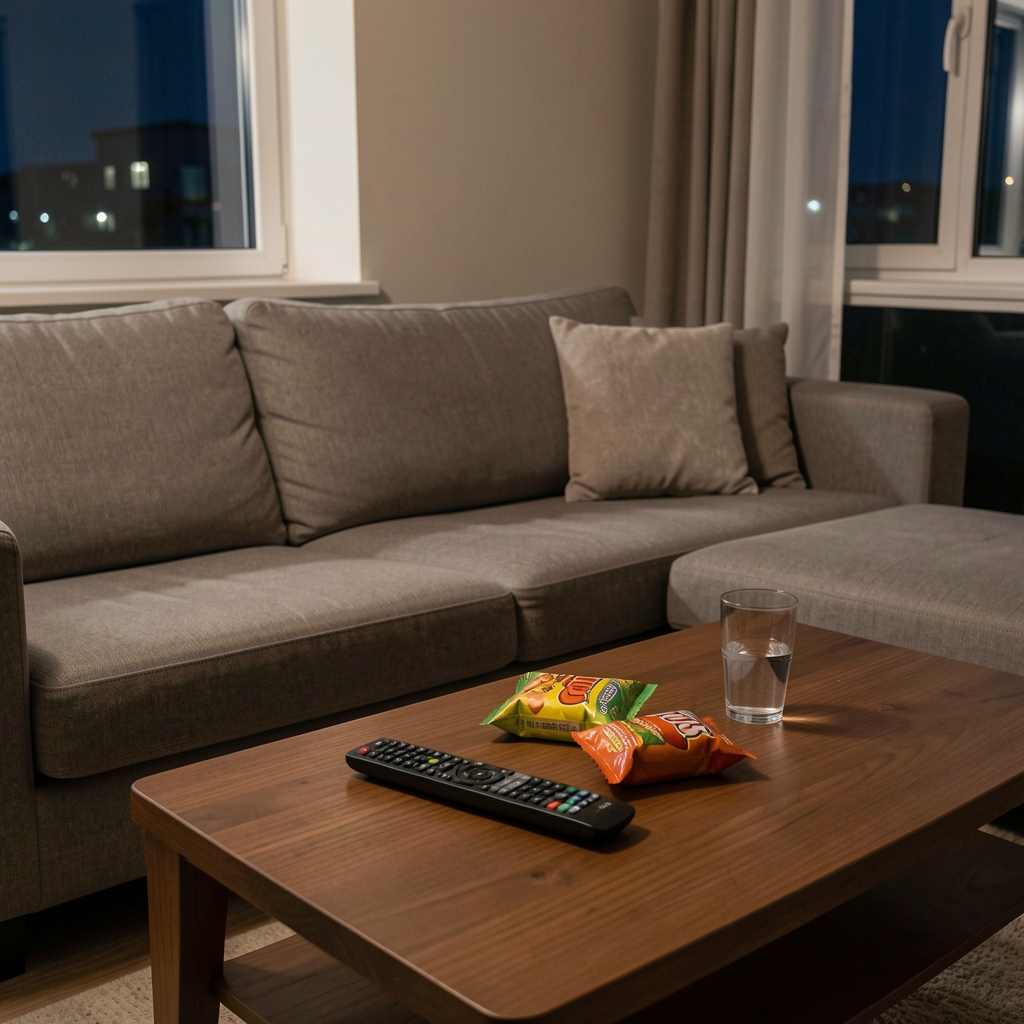
The foods consumed in late-evening eating occasions tend, across population studies, to be higher in refined carbohydrates, salt, and total energy than those consumed at planned mealtimes. This is not incidental. Late-evening eating frequently takes place in a low-deliberation context — in front of a screen, in a state of fatigue, often reaching into whatever is available rather than preparing something. The mindless snacking category (crisps, biscuits, sweets, crackers) dominates precisely because these items require no preparation, are commonly kept in accessible locations in the home, and deliver rapid sensory reward.
The circadian dimension adds a further layer of complexity. Timing of food intake in relation to the body's daily rhythm influences how that food is handled metabolically, with later eating occasions associated with altered energy processing in ways that are distinct from those of an identical meal consumed earlier. For the purposes of this piece, however, the behavioural question is the more practically useful one: what is it about the structure of the day that produces the evening as the primary site of unplanned eating?
Mindless Snacking and the Absent Decision
Mindless snacking is a phrase used loosely in popular accounts of eating behaviour, but it has a reasonably precise meaning in the research literature: eating that occurs with minimal conscious engagement, typically as a secondary activity accompanying something else (watching television, reading, working at a screen), and characterised by an absence of deliberate start and stop decisions. The person does not decide to begin eating and does not decide to stop; they continue until the packet is empty or attention is redirected.
The contribution of mindless snacking to total daily energy intake is frequently underestimated by the snacker. Studies employing dietary recall methods consistently find that snacking occasions — particularly those that occur in the two hours before sleep — are disproportionately underreported compared to planned meals. The eating did not feel significant enough to remember, and this is precisely what makes it significant: it operates beneath the threshold of the self-monitoring that would ordinarily produce some constraint on intake.
The physical accessibility of snack items is a structural determinant of mindless snacking frequency that is easy to alter and rarely considered. Research on food placement in the home consistently finds that items placed in direct sight and easy reach are consumed more frequently and in larger quantities than the same items placed out of sight or at a slight physical remove. The person who keeps a bowl of sweets on the desk next to the sofa will consume more of them than the person who keeps the same sweets in a kitchen cupboard — not because of differences in preference, but because of differences in the number of microseconds of friction between the impulse and the act.
This is not a counsel to remove all snackable food from the home. It is an observation that the structure of the immediate environment — the kitchen, the living room, the work space — shapes eating behaviour in ways that do not require willpower to address. Rearranging the environment is, in this sense, a more reliable intervention than attempting to override the environment through conscious effort at every opportunity the environment presents.
-
01.
Meal skipping does not reduce total daily intake for most people; it produces compensatory eating later that often exceeds the skipped meal in both quantity and energy density.
-
02.
Irregular eating patterns destabilise the anticipatory appetite signals that would ordinarily moderate intake at planned mealtimes, creating a structural difficulty in establishing consistency.
-
03.
Late-night eating is predominantly a consequence of insufficient eating earlier in the day, not an independent appetite anomaly — addressing the daytime structure tends to reduce it.
-
04.
The physical accessibility of snack items in the home is a more reliable determinant of mindless snacking than individual willpower — environmental arrangement is the practical lever.
Liquid Calories Awareness: The Invisible Intake
Liquid calories occupy a peculiar position in daily intake accounting. Research consistently demonstrates that the body registers the caloric contribution of beverages less effectively than it registers equivalent calories from solid food — meaning that a person who drinks two hundred calories in fruit juice before breakfast does not, in practice, eat two hundred fewer calories at breakfast to compensate. The calories are additive in physiological reality while being largely invisible in subjective self-assessment.
The scope of liquid calories awareness as a concern extends well beyond the obvious category of soft drinks. Fruit juices, smoothies, flavoured coffees, sweetened teas, energy drinks, sports drinks, and alcoholic beverages all contribute caloric content that the average person systematically underestimates. A medium cappuccino with full-fat milk contributes approximately 130 calories; two of these before noon represent a meaningful proportion of total daily intake that most people would not include in any mental accounting of what they have eaten.
The alcohol question is particularly pronounced in the context of irregular eating patterns. An evening with two glasses of wine represents perhaps 300-350 calories consumed in a context that does not feel like eating, and which is frequently not included in dietary self-reporting. When alcohol is paired, as it typically is in social contexts, with snack foods, the total caloric contribution of a single social evening can exceed that of a full meal while leaving the person with little sense of having eaten.
Liquid calories awareness does not require the continuous meticulous calorie-counting of every sip. It requires, rather, a revised mental category: beverages are part of the eating picture. The person who considers a careful lunch and a hurried dinner to have been a reasonable day's eating, without accounting for the two sweetened coffees, the afternoon smoothie, and the two evening glasses of wine, has an incomplete picture of their own intake that no amount of effort at the plate alone will adequately address.
What Consistent Meal Timing Asks of a Week
The argument for consistent meal timing is not an argument for rigid scheduling or clock-driven eating. It is an argument for predictability — for the week to have a recognisable eating architecture that the body and mind can both orient around. This architecture does not need to be precise; it needs to be sufficiently regular that the anticipatory systems activated in the hours before a typical mealtime can function as intended.
For many people working standard office schedules, the practical challenge is not motivation but logistics. A lunch that requires leaving the desk, preparing food, or locating an appropriate eating environment competes with a working culture that regards desk-eating as unremarkable and lunch breaks as optional. These structural conditions do not require willpower to resolve; they require a structural response — pre-prepared food, a reserved time, a physical relocation. None of these are technically difficult. Most of them are simply not habitual.
Building a weekly food rhythm — a phrase that encompasses both the regular timing of meals and the regular provisioning of food at home — is the environmental foundation on which more specific eating improvements rest. A person without that rhythm is attempting to make good individual food choices from a position of structural disadvantage: either too hungry at the decision point, or operating in an environment that defaults to convenience, or both simultaneously.
The evening, and the late-night snacking it so reliably produces, is the visible end of this chain. Addressing it at the point of visibility — with willpower, with removal of individual snack items, with rules about eating after 8pm — regards the symptom rather than the structure. The overlooked hours of the morning and midday are, for most people, where the actual work of gradual dietary improvement begins.